
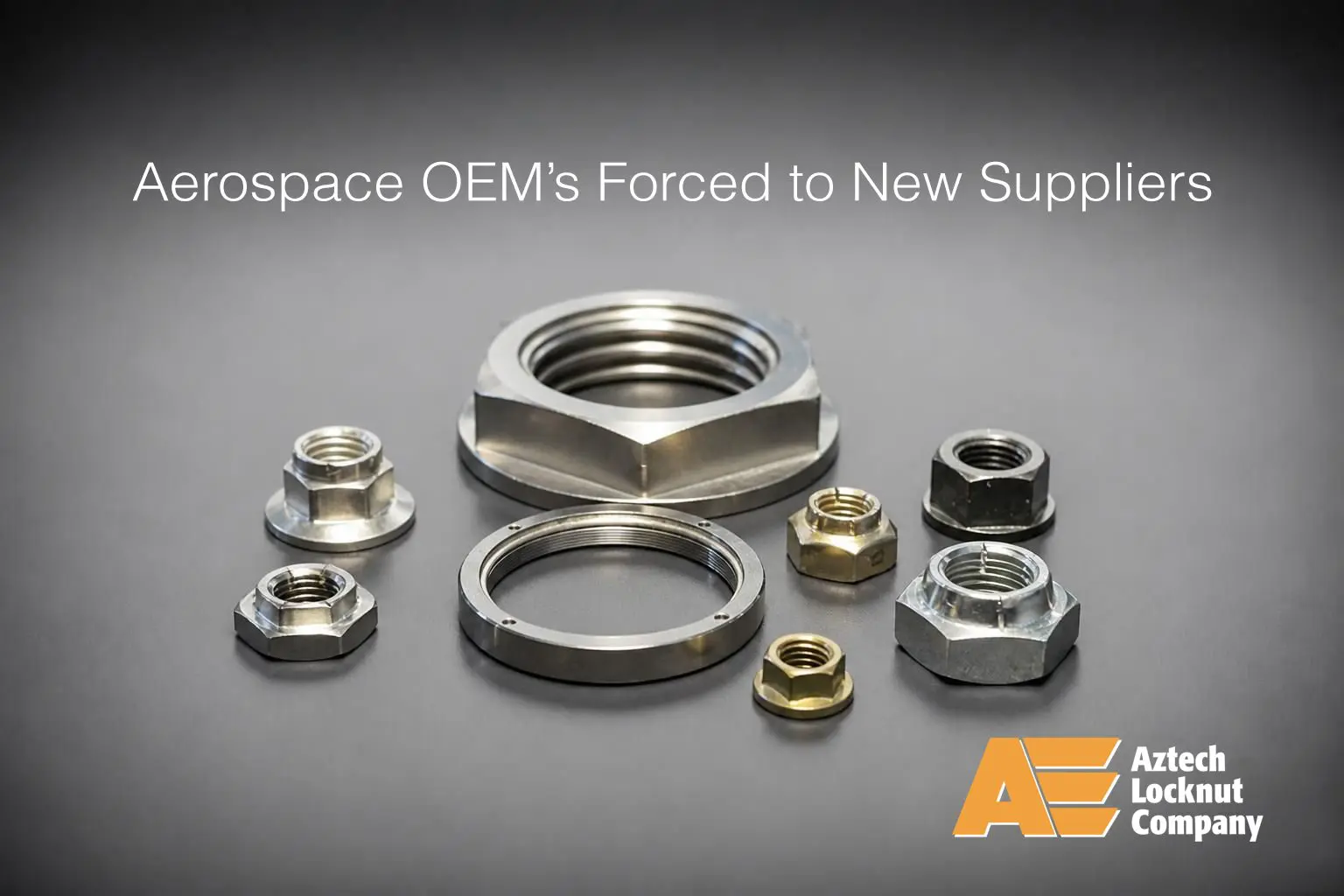
Aerospace OEM’s Forced to New Suppliers
There are no free-spinning nuts in aerospace.
Every nut installed on an aircraft carries a locking feature. Prevailing torque, castellated with a cotter pin, safety wire provision, or a self-locking insert—but always something. That isn’t a design preference. It’s a certification requirement, and it has been since the 1940s.
So the aerospace nut market and the aerospace locknut market are effectively the same market. Now look at what happened to the companies that make it.
The field used to be crowded.
Through the 1950s, ’60s, ’70s and ’80s, aerospace locknut production was spread across a genuinely competitive field: ESNA, Boots Aircraft Nut, Simmonds Aerocessories, Kaynar, Voi-Shan, Hi-Shear, Tridair, Rosan, Shur-Lok, SPS Technologies.
Most of those names still exist. Almost none exist independently.
| Year | Transaction | Value |
| 1995 | MacLean-Fogg acquires ESNA | — |
| 1999 | Fairchild acquires Kaynar Technologies | — |
| 2000 | Alcoa acquires Cordant Technologies, incl. Huck | $2.3B |
| 2002 | Alcoa acquires Fairchild Fasteners — Kaynar, Voi-Shan, Tridair, Rosan | $657M |
| 2003 | Precision Castparts acquires SPS Technologies | — |
| 2010 | LISI Aerospace acquires Hi-Shear | — |
| 2011 | Alcoa acquires TransDigm’s fastener businesses. | $240M |
| 2016 | Berkshire Hathaway acquires Precision Castparts. | ~$37B |
| 2016 | Novaria Group acquires ESNA Aerospace. | — |
| 2020 | Arconic becomes Howmet Aerospace. | — |
| 2026 | Howmet acquires Consolidated Aerospace Manufacturing | $1.8B |
Grand View Research now calls the market moderately concentrated, with Howmet, LISI, Precision Castparts and Stanley Black & Decker holding the bulk of it behind certification and capital barriers that keep newcomers out.
Here’s the part worth sitting with: the consolidation was financial, not technical. No acquirer above bought a superior locking element. They bought market share, specification approvals and qualification barriers. The mechanical art of prevailing torque hasn’t fundamentally advanced since the 1960s.
Why all-metal is where the pressure lands
Nylon insert locknuts top out around 250°F. Fine for plenty of airframe work; nowhere near sufficient for turbine and engine-adjacent hardware, which needs 450°F, 800°F, and sometimes 1200°F capability with repeated reuse.
That’s why the all-metal locknut exists: deformed thread crowns, elliptical and segmented collars, slotted collars, crimped rings. It’s understandably the hardest segment to qualify into.
The prevailing torque locknut traces to a 1925 Swedish patent; Carl Arthur Swanstrom brought a license to the U.S. in 1927 and founded the Elastic Stop Nut Corporation of America. Aviation qualification came in 1943, when the Air Force issued its first approval under AN-N-5. That lineage is unbroken:
AN-N-5 → MIL-N-25027 → NASM25027
When NASM25027 appears on a certification package today, it’s the same requirement, in a direct line, written for military aircraft in the 1940s. Eighty years of continuity is much of why substitution is an engineering change rather than a purchasing decision.
February 17, 2025
That night, a four-alarm fire with explosions tore through the SPS Technologies plant in Abington Township, Pennsylvania. It took 68 fire companies to fight and burned for days. Roughly 60 employees were inside; all evacuated safely, no injuries. The fire department later ruled the cause accidental and undetermined, originating in a compressed air system.
The plant had made aerospace fasteners on that site since 1903 — high-tolerance corrosion-resistant bolts, wrenchable and self-locking nuts, and related hardware for platforms including the 737, the F-35 and Navy vessels. The Philadelphia Inquirer reported that SPS was the only approved federal supplier, or one of very few, on a number of items — some classified by the Pentagon as Critical Application Items. About 250 people were laid off afterward.
SPS is rebuilding seriously: a new facility on the same site, roughly 350,000 square feet, LEED certified, targeted operational in 2028. Nobody in this industry is rooting against them.
But the arithmetic is the arithmetic. The old plant ran 560,000–600,000 square feet with just under 500 factory workers. The replacement is planned at 350,000 square feet with around 200 workers. That’s a three-year hole in domestic capacity in a narrow product category — and it’s already eighteen months old.
Why Aerospace OEM’s can’t simply shop around.
When a plant making ordinary fasteners goes down, purchasing shops around. When a plant making specification-controlled aerospace hardware goes down, purchasing discovers a much different challenget.
The specification decides who is allowed to supply the part — not the market, not the buyer, not how urgent it is. And as analysts at Exterra note, qualifying a new manufacturer against a National Aerospace Standard can run 18 to 36 months. The eligible pool doesn’t expand because demand spiked.
Then layer on process bottlenecks. Aerospace-grade conversion—forging, grinding, plating, dry film lube, NDT, batch documentation — can add 4 to 10 weeks, with 12- to 52-week lead times now normal. One delayed Nadcap-linked step holds the whole lot.
It hits hardest on defense programs with single-name source lists, engine applications where material qualification, stacks on part qualification, and MRO shops on legacy platforms where capacity has migrated to newer programs.
What consolidation does to demand.
When an acquisition moves a portfolio into an organization optimized for rate production on current programs, that organization inherits the acquired company’s low-volume, legacy, and specialty part numbers. Those can be a cost burden to be purged. So they get quoted at deterrent prices, quoted with impossible lead times, or declined outright.
The demand doesn’t disappear. It relocates to whoever will take it.
Every transaction above did some version of this. Kaynar’s legacy catalog, Voi-Shan’s, Tridair’s, Rosan’s, Hi-Shear’s, SPS’s, and now CAM’s have each passed into an organization that may have less appetite for small-lot work than the company that built it.
If you’ve been told, in so many words, your part number is no longer of interest, you may be part of this trend. You’re experiencing the predictable output of twenty-six years of industry consolidation.
What OEM’s can do
- Pre-qualify alternates now. An 18-to-36-month clock started today beats one started in a crisis.
- Treat special processes as capacity assets. Plating, heat treatment, and NDT deserve the same scrutiny as the part.
- Buffer the no-substitute parts. Lean inventory works until the part has one approved source.
- Ask about open capacity, not just price. A quote means nothing if the machine time doesn’t exist.
- Ask who will actually take your small lot. Willingness is a capability.
Where Aztech fits
That last question — who will actually take the small lot — is the one we built the company to answer.
Aztech has been engineering prevailing-torque locking features in Aurora, Illinois since 1978. The locking element isn’t a product line here; it’s the entire purpose of the company, which is a different proposition than being a line item in someone’s portfolio.
What that has meant in practice:
- We developed the all-metal process ourselves, because it couldn’t be bought. We committed to be the highest output, highest quality and lowest cost manufacturer, first of industrial, now of certified all-metal production. No supplier anywhere offered the equipment capable of the output and precision we defined. So we designed and built our own. That muliti-process world class capability is proprietary to Aztech.
- We took the hardest configuration first. Rather than proving an easy part and working up, we developed high-temperature stainless all-metal locknuts, arguably the most difficult all-metal locknut to produce. It took an extensive investment in time and resources, but we have exceeded our goals and projections, and have delivered product in volume to a rapidly growing customer base.
- We hold the credentials primes ask for. AS9100D, an ISO/IEC 17025 accredited lab with a published decision rule of conformity, NIST 800-171 compliance with a CMMC program in place, and prime flowdown requirements in active practice.
- We have open capacity and we’re adding more. Machine and tooling are being scaled out currently, specifically to take on aerospace volume.
Domestic, spec-governed, small-lot capable, and available. If your incumbent has stopped quoting a part number you need, it may be time for a conversation with Aztech.
The fire in Abington was an accident. The fragility it exposed was not. It was the cumulative result of a thousand individually reasonable efficiency decisions that left a critical product category with no slack in it. Rebuilding slack takes longer than losing it did, which is a good argument for starting now.
Infographic specs
1. Consolidation map: “Ten Names Into Three” — Sankey or collapsing-tree. Left: the 1950s–80s field. Flow through the transaction years to the right: Howmet, PCC, LISI, plus a fourth flow labeled “fragmented tier.” The hero asset; nobody else has drawn it.
2. Spec lineage timeline — 1925 patent → 1927 US license → ESNA founded → 1943 USAF approval (AN-N-5) → MIL-N-25027 → NASM25027.
3. Temperature ladder: “Why All-Metal Exists” — Nylon ceiling (~250°F) against all-metal bands (450 / 800 / 1200°F), annotated with typical applications.
4. Flow diagram: “Where Displaced Demand Goes” — Acquisition → portfolio absorbed into rate-production organization → legacy part numbers deprioritized → demand relocates to fragmented tier.
Sources
Howmet Aerospace (CAM, TransDigm) · FlightGlobal · Grand View Research · WHYY · NBC10 Philadelphia · Philadelphia Inquirer · MONTCO.Today · SPS Updates · Exterra · SmartIndu News